Strong Feet, Stable Ankles: The Missing Link in Balance and Movement
Mar 22, 2026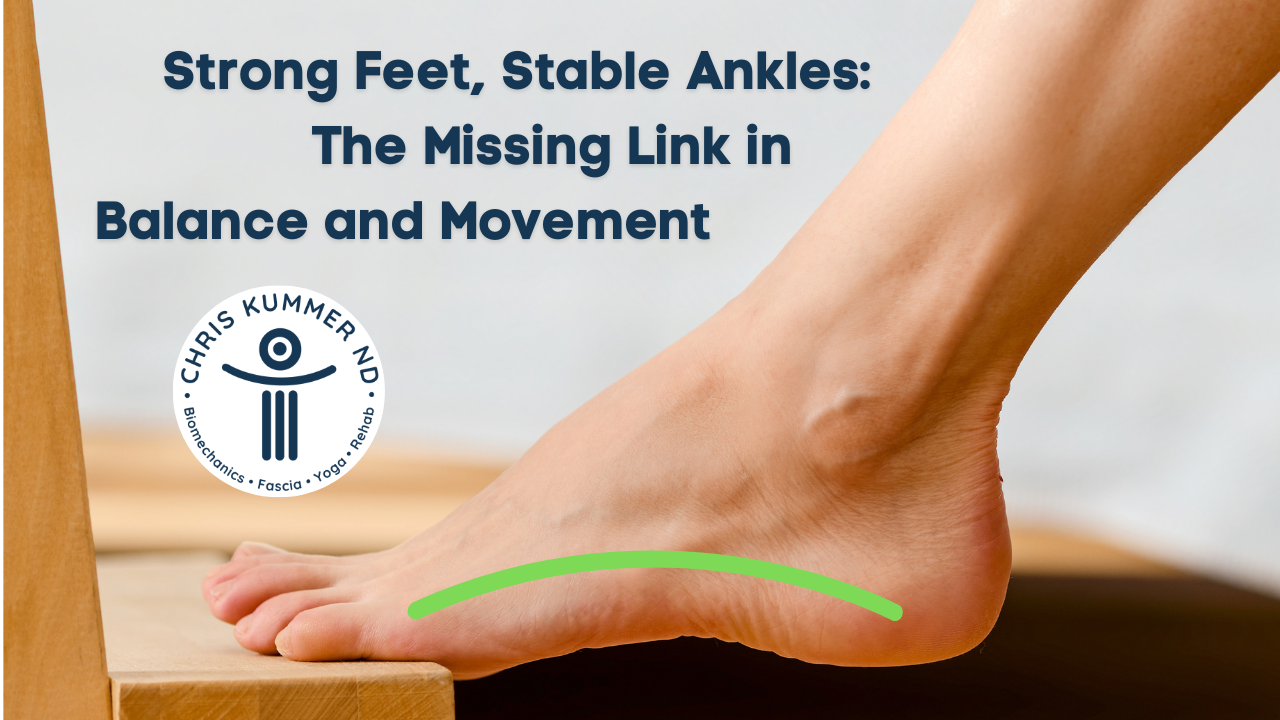
If you want better balance, stronger movement, and more stable joints, most advice points you upward—to the core, the hips, or overall strength.
But the real starting point is much lower.
Your feet and ankles.
They form the foundation of every step, every transition, and every balance. Yet for many people, they are the least trained, least understood, and most underused part of the body.
If your balance feels inconsistent, your knees feel vulnerable, or your movement lacks stability, the issue may not be where you think.
It may begin at the ground.
The Foundation You Stand On
Your feet are your primary point of contact with the world.
Every force you produce—or absorb—passes through them.
When that foundation is strong, responsive, and adaptable, the rest of your body has something reliable to work from.
When it’s not, everything above it has to compensate.
This is why limitations in the feet and ankles can show up as:
-
Poor balance
-
Knee discomfort
-
Hip instability
-
Reduced movement efficiency
The body doesn’t operate in isolated parts. It functions as a system—and the system starts at the ground.
Why Foot Strength Matters More Than You Think
Foot strength isn’t just about gripping your toes or “trying harder.”
It’s about the ability of the foot to:
-
Maintain structure under load
-
Adapt to changing surfaces
-
Provide accurate sensory feedback
-
Support efficient force transfer
The foot contains a complex network of small muscles and connective tissues that help maintain the arch and control movement.
When these structures are underused—often due to supportive footwear or lack of training—the foot becomes less responsive.
This affects everything above it.
The Role of the Ankle
Just above the foot, the ankle acts as a translator.
It takes information from the ground and turns it into movement adjustments.
A well-functioning ankle needs both:
-
Mobility to allow movement
-
Stability to control that movement
If the ankle is stiff, movement gets redirected elsewhere—often into the knee.
If it’s unstable, the body struggles to maintain balance and alignment.
This is why improving ankle function is one of the most effective ways to improve overall movement quality.
The Chain Reaction Up the Body
When the foot and ankle are not doing their job, the body adapts.
For example:
-
A collapsing arch may lead to inward knee movement
-
A stiff ankle may limit squat depth
-
Poor foot control may reduce balance efficiency
These are not isolated problems—they’re part of a chain reaction.
Improving the base of that chain can often resolve issues further up without needing to directly target them.
Balance Starts at the Ground
If you’ve ever struggled with balance, you may have been told to “engage your core” or “focus harder.”
But balance is not just about concentration.
It’s about feedback and response.
Your feet provide the feedback.
Your ankles and legs provide the response.
If the feedback is unclear—or the response is poorly coordinated—balance becomes more difficult.
This is explored in more detail in this article on
why balance feels unstable and how to improve it from the ground up,
where we look at how the standing leg and foot work together to create stability.
Bringing This Into Practice: Warrior 3
This connection becomes very clear in single-leg balance postures like Warrior 3.
In theory, it’s a simple shape: one leg grounded, the rest of the body extending outward.
In practice, it reveals everything about how you use your foundation.
If the foot is passive, the ankle unstable, or the standing leg under-engaged, the posture becomes difficult to control.
Many practitioners try to compensate by working harder in the lifted leg or upper body.
But the real solution lies below.
In this article on
the most common mistake in Warrior 3 and how to fix your standing leg stability,
you’ll see how improving engagement from the foot to the hip can transform the pose completely.
What Strong Feet Actually Feel Like
Strong feet are not rigid or tense.
They are:
-
Active without gripping
-
Responsive to subtle shifts
-
Able to distribute pressure evenly
-
Connected to the rest of the leg
You might feel a gentle lift through the arch, a spreading of the toes, and a sense of contact through multiple points of the foot.
This creates a stable yet adaptable base.
Simple Ways to Build Foot and Ankle Strength
You don’t need complicated exercises to start improving foot and ankle function.
Small, consistent practices can make a big difference.
1. Spend Time Barefoot
Walking or standing barefoot (where appropriate) increases awareness and activation in the feet.
2. Practice Short Balance Holds
Stand on one leg for short periods, focusing on how your foot interacts with the ground.
3. Explore Weight Shifts
Gently shift your weight forward, back, and side to side to improve control and responsiveness.
4. Strengthen the Calf and Ankle
Simple movements like calf raises help build strength and support around the ankle.
5. Train Variety
Include different surfaces, speeds, and directions to challenge the system.
Integration Over Isolation
It’s tempting to think of foot strength, ankle mobility, and balance as separate goals.
But in reality, they are deeply connected.
Training them together—rather than in isolation—leads to better results.
A strong foot supports a stable ankle.
A stable ankle supports an efficient leg.
An efficient leg supports balanced movement.
The Bigger Perspective
Improving foot and ankle function is not just about performance or injury prevention.
It’s about how you move through the world.
Better balance.
More efficient walking.
Greater confidence in movement.
All of these begin at the ground.
Where to Go Next
If this has highlighted something in your own movement, the next step is to explore how these principles show up in specific contexts.
Start with balance:
👉 Why balance feels unstable and how to improve it from the ground up
Then apply it to a posture:
👉 The most common mistake in Warrior 3 and how to fix your standing leg stability
Together, these articles will help you connect the dots between foot function, ankle stability, and full-body movement.
Final Thought
Strong, responsive feet and stable ankles don’t just improve isolated skills.
They change the way your entire body moves.
And when your foundation works well, everything above it becomes easier.
Are you thinking 'yeah this makes sense to me'?
Most important now is to keep your movement practice up. Maybe you want to integrate. and try out what the blog post added to your ideas. Then add to your knowledge. Keep expanding. We are always changing - stay adaptable to make the most of all the situations of your life.
JOIN MY NEWSLETTER
Subscribe to get my latest movement related content by email.
Double opt-in, please click 'confirm subscription' in your email inbox
