Are You Still Making This Mistake in Warrior 3?
Mar 19, 2026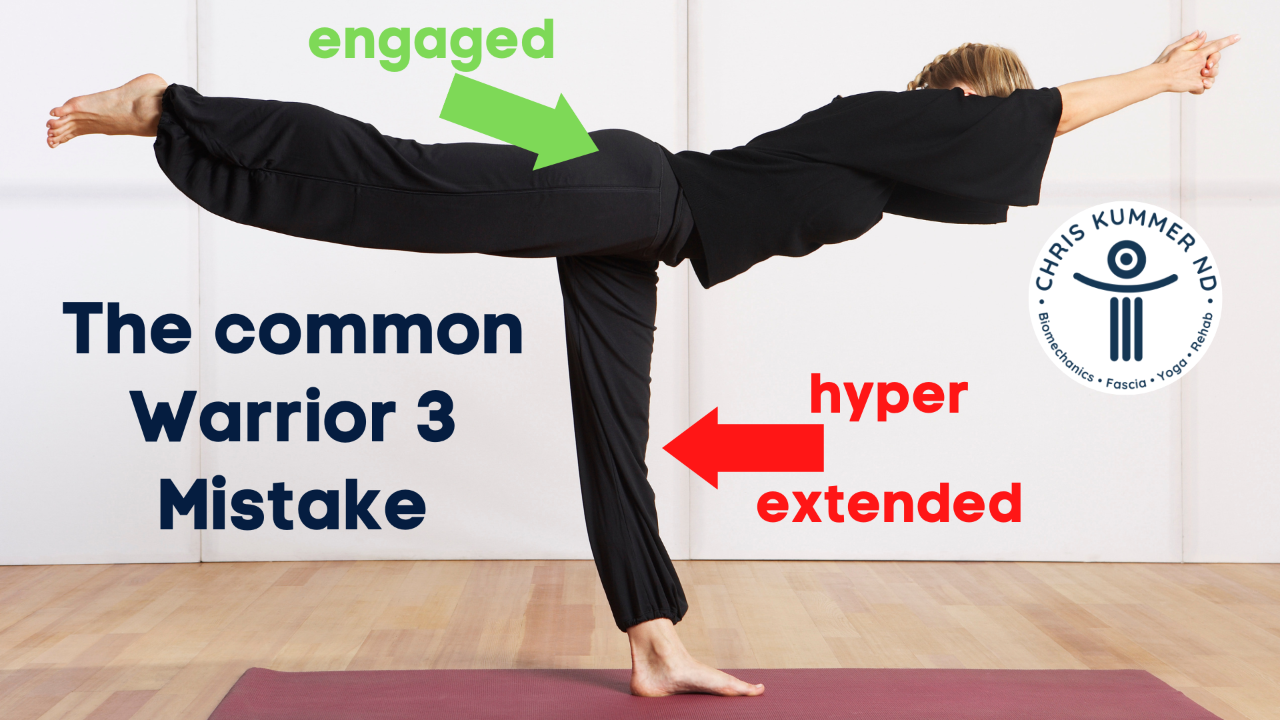
Warrior 3 is often celebrated as a powerful and elegant posture. It asks for strength, balance, coordination, and control—all at once. When it comes together, it feels light, stable, and almost effortless, as if the body is suspended in space.
But for many practitioners, there’s a subtle mistake hiding in plain sight.
It doesn’t always look wrong. In fact, it can look quite strong. The lifted leg is high, the torso is long, and there’s a clear sense of effort. Muscles are working—especially in the hamstrings and glutes of the lifted leg.
So everything’s fine… right?
Not quite.
The Illusion of Effort
In Warrior 3, most people feel immediate engagement in the hamstrings of the lifted leg. The glutes often fire strongly as well, helping to lift and hold the leg in position. This can create a convincing sense that the pose is “active” and well-supported.
And yes—those muscles are absolutely working.
But here’s the question worth asking:
Are you actually using your whole body—or just the parts that are shouting the loudest?
Because effort is not the same as integration.
And in many cases, what feels like a strong pose is actually a partially engaged system compensating for a weak foundation.
What About the Rest of the Leg?
Let’s stay with the lifted leg for a moment.
Beyond the hamstrings and glutes, what else is contributing?
The quadriceps, the large muscles at the front of the thigh, may come into play—especially if you’re consciously straightening the knee. That’s useful. It adds another layer of muscular support.
But even here, we’re still only working with part of the system.
What about the inner thigh muscles—the adductors?
These muscles are often overlooked, yet they play a crucial role in stabilizing the pelvis. In Warrior 3, your entire torso and lifted leg are essentially extending out from the pelvis like a long lever. Without inner thigh engagement, that lever becomes harder to control.
Subtle wobbling, shifting, or gripping elsewhere in the body often traces back to this missing support.
So even in the lifted leg, there’s more available than we tend to use.
Now Let’s Talk About Balance
Before we even get to the standing leg, consider this:
Balance in Warrior 3 is not just about staying upright—it’s about how efficiently your body distributes effort.
If the lifted leg and torso are working hard, but the base of support is underperforming, the whole system becomes unstable.
And that brings us to the most common issue in this posture.
The Real Problem: The Standing Leg
The standing leg is the foundation of Warrior 3.
And yet, it’s often the least effectively engaged part of the pose.
At first glance, it may feel active. There may be sensation, intensity, even strain. But sensation alone doesn’t tell us whether the right muscles are doing the right job.
In fact, many practitioners—especially those with naturally mobile joints—fall into a familiar pattern:
Knee hyperextension.
Hyperextension: Strength or Illusion?
If your standing knee moves slightly backward beyond neutral, you’re likely experiencing hyperextension.
In that position, it can feel like the leg is “locked” and stable. But structurally, something very different is happening.
Instead of muscular support, the joint is relying on passive structures—ligaments, joint capsule, and connective tissue—to hold it in place.
You might feel:
-
Sensation at the back of the knee
-
Stretching in the hamstrings
-
A sense of “hanging” into the joint
This can easily be mistaken for strength.
But it’s not active support—it’s passive loading.
Where Are the Hamstrings?
Here’s a key insight:
The hamstrings bend the knee.
So if your knee is pushed into hyperextension—the opposite of bending—your hamstrings are not in a strong, active position.
In fact, they’re more likely being lengthened and placed under tension without contributing much to stability.
That means one of the key stabilizers of the knee joint is effectively offline.
The Quadriceps Trap
Many practitioners rely heavily on the quadriceps to stabilize the standing leg.
And to be fair, the quadriceps are doing something—they help extend the knee and create a sense of firmness in the leg.
But when used alone, they tend to drive the knee further into extension, reinforcing hyperextension rather than preventing it.
This creates a kind of imbalance:
-
Strong front-of-thigh effort
-
Reduced contribution from the back of the leg
-
Minimal engagement from the inner thigh
It may feel like effort—but in reality, it’s only a fraction of the support the leg is capable of generating.
A More Complete Approach to Stability
Imagine your standing leg not as a single line of effort, but as a 360-degree system of support.
A well-integrated standing leg in Warrior 3 includes:
-
Foot engagement for grounding and responsiveness
-
Calf muscles contributing to balance and control
-
Hamstrings gently active to prevent hyperextension
-
Quadriceps supporting without dominating
-
Adductors (inner thigh) stabilizing the pelvis
-
Outer hip muscles helping maintain alignment
When these elements work together, the leg becomes not just strong—but intelligently stable.
What Changes When You Do This?
When the standing leg is properly engaged, several things shift:
1. The Knee Feels Supported (Not Locked)
Instead of hanging into the joint, there’s a subtle sense of muscular lift and control around the knee.
2. Balance Improves
With a more responsive base, the body doesn’t need to overcompensate elsewhere.
3. The Lifted Leg Feels Lighter
When the foundation is stable, the effort in the lifted leg decreases. You no longer need to grip or overwork to stay in the pose.
4. Tension Reduces
Excess effort in the shoulders, neck, or lower back often fades when the standing leg does its job.
A Simple Cue to Try
Next time you practice Warrior 3, experiment with this:
Instead of pushing the standing knee back, think about softening it just slightly—not bending deeply, but moving away from the end range.
From there:
-
Gently engage the hamstrings as if resisting that backward movement
-
Feel the inner thigh draw upward toward the pelvis
-
Stay connected through the foot and ankle
You may find that the pose feels different—less rigid, but more stable.
Rethinking Strength in Yoga
This is where the conversation becomes more interesting.
In yoga, strength is often associated with visible effort—how hard something feels, how much the muscles are working, how intense the posture appears.
But real strength is not just about effort.
It’s about coordination, distribution, and timing.
Warrior 3 is not a test of how hard you can work your lifted leg. It’s an exploration of how well your entire system can organize itself around a single point of contact with the ground.
The Bigger Picture
What shows up in Warrior 3 often reflects broader movement patterns.
Do you rely on passive structures for stability?
Do certain muscles dominate while others remain underused?
Do you equate intensity with effectiveness?
These are not just yoga questions—they’re movement questions.
And they show up in walking, running, standing, and training.
Bringing It Into Your Practice
The next time you come into Warrior 3, shift your focus:
Not to how high you can lift your leg.
Not to how long you can hold the pose.
But to how you’re using your standing leg.
Build the posture from the ground up.
Engage the leg from foot to hip.
Let stability come from integration, not tension.
A Question to Explore
What tools or cues help you create a more supported, stable standing leg?
If balance in this pose feels inconsistent, it may not be about balance itself.
Read more about why balance feels unstable and how to fix it from the ground up.
Do you:
-
Slightly soften the knee?
-
Actively engage the hamstrings?
-
Use the inner thighs to stabilize the pelvis?
-
Focus on foot connection and balance?
There’s no single “correct” answer—but there is a more complete one.
And finding it can transform not just your Warrior 3, but the way you move as a whole.
Are you thinking 'yeah this makes sense to me'?
Most important now is to keep your movement practice up. Maybe you want to integrate. and try out what the blog post added to your ideas. Then add to your knowledge. Keep expanding. We are always changing - stay adaptable to make the most of all the situations of your life.
JOIN MY NEWSLETTER
Subscribe to get my latest movement related content by email.
Double opt-in, please click 'confirm subscription' in your email inbox
