Why Your Balance Feels Unstable (It’s Not What You Think)
Mar 21, 2026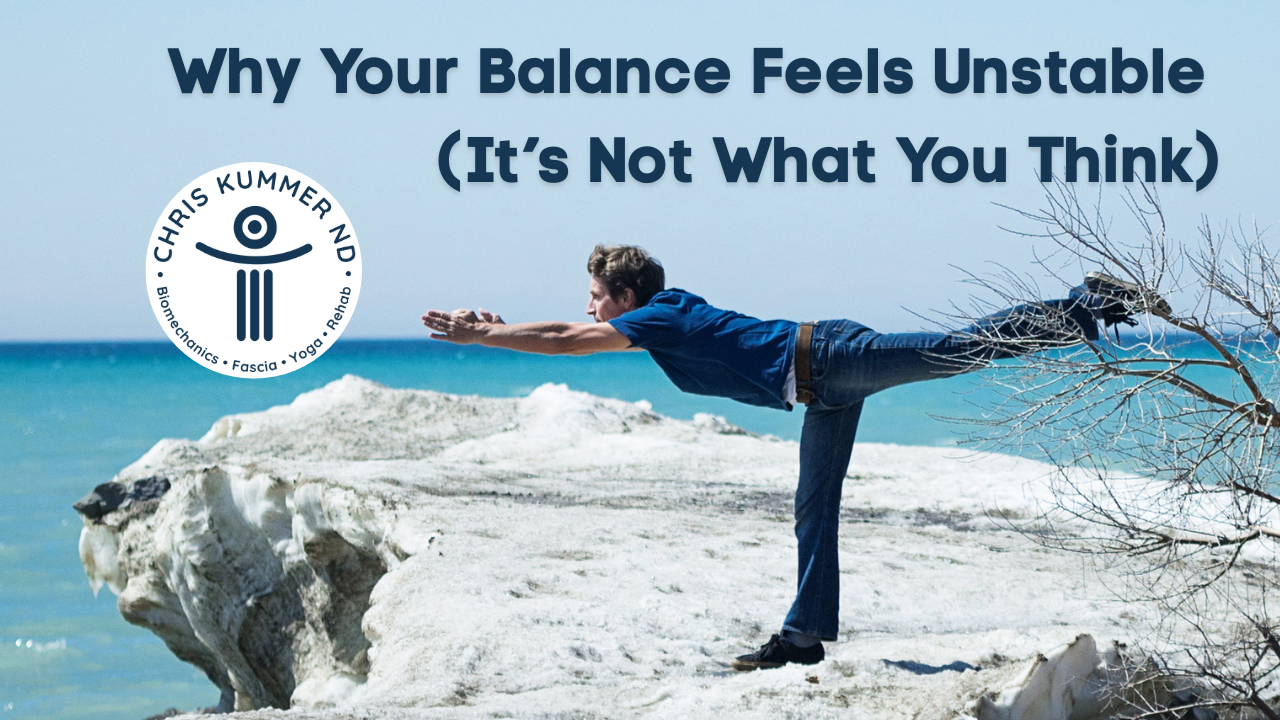
Balance is often treated as a simple skill: stand on one leg, hold still, try not to fall.
If it feels difficult, the usual advice is to “engage your core,” focus harder, or just practice more.
But what if instability in balance postures isn’t really about balance at all?
What if the real issue lies in how your body organizes itself—particularly from the ground up?
In this article, we’ll explore why balance often feels shaky, what’s actually happening in your body, and how improving your foundation—especially through the standing leg—can dramatically change your experience.
Balance Is Not Just About Stillness
When you stand on one leg, your body is not trying to be perfectly still. In fact, it’s constantly making small, subtle adjustments.
These micro-movements are essential. They allow you to respond to shifts in weight, changes in pressure, and variations in muscle activity.
Balance, then, is not the absence of movement—it’s the ability to adapt to movement.
And this adaptation depends heavily on how well different parts of your body are communicating and working together.
Where Balance Really Begins
Most people think of balance as something controlled by the core or upper body.
But in reality, balance starts at the foot and ankle.
Your foot is the only point of contact with the ground. It provides the sensory input that tells your brain where you are in space. The ankle then translates that information into movement adjustments.
If this system isn’t working well, everything above it becomes less stable.
This is why even small improvements in foot and ankle function can have a noticeable impact on balance.
The Role of the Standing Leg
From the foot, balance moves upward into the standing leg.
This is where many people unknowingly lose efficiency.
In single-leg balance—whether in yoga postures like Warrior 3, or in everyday movements—the standing leg must do more than just “hold you up.”
It needs to:
-
Absorb and respond to shifting forces
-
Stabilize the knee joint
-
Support the pelvis
-
Coordinate with the foot and hip
When this doesn’t happen, the body compensates elsewhere.
You might grip in the toes.
You might tense the shoulders.
You might overwork the lifted leg.
All of these are signs that the foundation isn’t doing its job.
The Hidden Issue: Passive Stability
One of the most common reasons balance feels unstable is over-reliance on passive structures.
This often shows up as:
-
Locking the knee
-
Hanging into the hip
-
Collapsing into the arch of the foot
At first, this can feel stable. There’s a sense of “resting” into the joint rather than actively supporting it.
But passive stability has limits.
It reduces the body’s ability to adapt, making balance more fragile and less responsive.
Active Stability: What You’re Missing
Active stability comes from muscle engagement that supports and controls joint position.
In the standing leg, this includes:
-
Foot muscles maintaining contact with the ground
-
Calf muscles adjusting for small shifts in balance
-
Hamstrings helping to control the knee
-
Quadriceps providing support without locking
-
Inner thigh (adductors) stabilizing the pelvis
-
Hip muscles maintaining alignment
This is not about tensing everything as hard as possible.
It’s about creating a balanced level of engagement across the entire leg.
Why More Effort Doesn’t Fix Balance
When balance feels difficult, the instinct is often to try harder.
But more effort usually leads to more tension—not better coordination.
You might notice:
-
Holding your breath
-
Tightening your jaw
-
Gripping through the shoulders or neck
These strategies can temporarily help you stay upright, but they don’t address the underlying issue.
In fact, they often make balance less efficient by interfering with the body’s natural ability to adapt.
The Connection to Warrior 3
This pattern becomes especially clear in postures like Warrior 3.
Many practitioners focus on lifting the leg higher, extending the arms, or “holding the shape.” Meanwhile, the standing leg is quietly underperforming.
The result?
A posture that looks strong but feels unstable.
If this sounds familiar, it’s worth exploring the role of the standing leg more closely.
In fact, this is exactly what I break down in more detail in the related article on
the most common mistake in Warrior 3 balance and standing leg stability
That post dives deeper into how hyperextension, muscle imbalance, and incomplete engagement can undermine both stability and strength in the pose.
A Simple Shift That Changes Everything
Instead of focusing on staying perfectly still, try shifting your attention to how you’re standing.
Next time you balance on one leg:
-
Feel your weight spread across the foot
-
Avoid locking the knee into its end range
-
Gently engage the muscles at the back of the leg
-
Notice the inner thigh lifting and supporting the pelvis
These small changes can create a big difference.
Balance becomes less about effort—and more about organization.
Training Balance More Effectively
If you want to improve balance, it helps to train it in a way that reflects how the body actually works.
Rather than holding static positions for long periods, consider:
1. Short, Repeated Holds
Practice balancing for shorter durations with better quality of engagement.
2. Movement-Based Balance
Shift in and out of balance rather than staying still. This builds adaptability.
3. Barefoot Practice
Training without shoes can improve foot awareness and activation.
4. Varied Surfaces
Practicing on slightly unstable surfaces can challenge the system in useful ways.
Balance Is a Skill, Not a Trait
It’s easy to think of balance as something you either have or don’t have.
But balance is highly trainable.
And more importantly, it’s specific.
Improving balance is less about general ability and more about how well your body coordinates in a particular context.
That means you don’t need to become “better at balance” in a broad sense.
You just need to improve how your body organizes itself in the positions you care about.
Bringing It All Together
If balance feels unstable, it’s rarely just a balance problem.
More often, it’s a coordination problem.
A foundation problem.
A distribution-of-effort problem.
By shifting your focus to the foot, ankle, and standing leg, you can build a more stable base—one that supports the rest of your body with less effort and more efficiency.
And when that foundation improves, balance often follows naturally.
Where to Go Next
If you want to explore this further, take a closer look at how you use your standing leg in specific postures.
One place to start is Warrior 3.
👉 Read: Are You Still Making This Mistake in Warrior 3?
It will give you a practical, detailed look at how improving standing leg engagement can transform not just that pose—but your balance as a whole.
Are you thinking 'yeah this makes sense to me'?
Most important now is to keep your movement practice up. Maybe you want to integrate. and try out what the blog post added to your ideas. Then add to your knowledge. Keep expanding. We are always changing - stay adaptable to make the most of all the situations of your life.
JOIN MY NEWSLETTER
Subscribe to get my latest movement related content by email.
Double opt-in, please click 'confirm subscription' in your email inbox
