How Forward Head Posture Influences Your Yoga Practice
Apr 10, 2026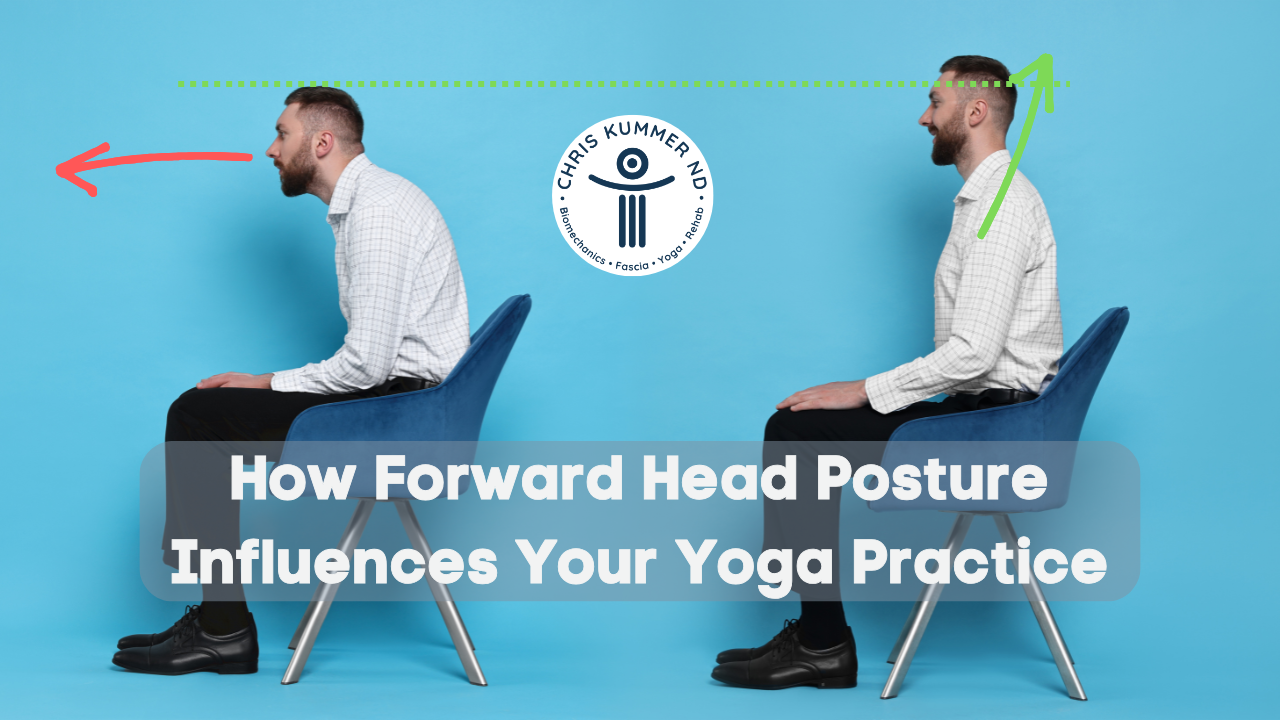
Why a small shift in head position can reshape your entire yoga experience.
Forward head posture (FHP) has become one of the most widespread postural patterns of modern life. Hours at computers, phones, steering wheels, and even some yoga habits subtly nudge the head further and further in front of the body’s natural plumb line.
In daily life, this often shows up as shoulder tension, headaches, jaw tightness, and compressed breathing.
But in yoga practice, the effects are magnified: forward head posture influences how you breathe, how you bear weight, how you move through transitions, and even how safe your neck and upper spine are in backbends or inversions.
Many practitioners don’t realise that their challenges in postures such as Cobra, Upward Dog, Plank, Chaturanga, Shoulderstand, Bow, or even simple standing poses are directly linked to the way their head rests on their spine.
In this post, we’ll look at the deeper anatomy behind forward head posture, how it affects your yoga practice, and what you can modify today to move with more ease, strength, and clarity.
1. What Is Forward Head Posture, Really?
Forward head posture happens when the head is positioned in front of the shoulders rather than stacked directly above them.
Most people think:
“My head is just a little forward.”
But the reality is more dramatic.
For every centimetre your head moves forward, your neck muscles must support an additional 4–5 kilograms of load.
That means:
- a small shift becomes a major effort
- deep neck flexors weaken
- upper trapezius and levator scapulae overwork
- fascia along the front of the neck and chest shortens
- the cervical spine loses its natural curve
- the thoracic spine stiffens to compensate
Once this pattern settles in, it shapes all movement — including your yoga practice.
2. How Forward Head Posture Shows Up on the Mat
Forward head posture influences yoga in ways that aren’t always obvious.
Here are the most common patterns:
A. “Lead-with-the-chin” backbends
When the head sits forward, the neck often becomes the first part to move in extension.
Instead of the spine extending in a smooth arc, the neck collapses backward.
This shows up strongly in:
- Cobra
- Upward Facing Dog
- Camel
- Wheel
- Dancer
- Bow
The result?
Neck compression, headaches, and difficulty activating the upper back.
B. Rounded upper spine in weight-bearing poses
In poses like:
- Plank
- Chaturanga
- Downward Dog
- Forearm Stand
- Handstand
A forward head tends to pull the upper thoracic spine into flexion (rounding).
This weakens shoulder mechanics and makes weight-bearing feel harder than it needs to.
C. Reduced breathing capacity in both stillness and flow
Forward head posture shortens the deep front line of the fascia.
This limits:
- diaphragm excursion
- rib movement
- upper lung expansion
- deep breath access
In yoga, this means:
- breath cues are harder to follow
- pranayama becomes constrained
- transitions feel heavier
- fatigue arrives sooner
D. Difficulty maintaining balance
Head position influences the vestibular system.
When the head sits far forward, balance becomes more work.
This becomes obvious in:
- Tree
- Warrior III
- Half Moon
- Standing splits
- Any dynamic flow
The nervous system is busy compensating for the forward-shifted centre of mass.
3. Why Forward Head Posture Affects the Entire Spine
The cervical spine connects directly into the thoracic spine, rib cage, and shoulder girdle.
When the head moves forward, several structural compensations follow:
- Thoracic spine stiffens to “hold” the head weight.
- Shoulders round because the upper back no longer supports them.
- Lower back compresses to counter-balance the forward load.
- Pelvis tilts to stabilise the chain.
- Breathing muscles tighten because the rib cage position changes.
This means forward head posture isn’t just a neck issue — it’s a full-body posture issue.
And yoga, with its emphasis on full-body integration, magnifies both the challenges and the potential for improvement.
4. How Forward Head Posture Changes Specific Postures
Let’s break down a few common poses.
Cobra & Upward Dog
With FHP:
- head drops back prematurely
- cervical spine hyper-extends
- rib cage can’t lift
- shoulders creep toward the ears
With better alignment:
- spine lengthens
- collarbones open
- head follows the chest, not the other way around
- backbend spreads evenly
Downward Dog
With FHP:
- neck feels tight or “short”
- shoulders roll inward
- upper back rounds
- weight shifts into the wrists
With better alignment:
- spine lengthens from pelvis to crown
- neck relaxes
- shoulders externally rotate naturally
- weight distributes evenly
Plank & Chaturanga
With FHP:
- head drops
- shoulders collapse
- elbows flare
- neck and upper back fatigue
With correction:
- head aligns with spine
- core activates reflexively
- shoulders stabilise
- transitions feel cleaner and stronger
nversions
With FHP, headstand or forearm stand becomes a battle:
- body alignment stacks poorly
- neck feels vulnerable
- shoulders fatigue faster
- balance becomes unpredictable
When head position improves, inversions become dramatically safer and steadier.
5. Three Simple Experiments to Feel the Difference
A. “Head Over Heart” Standing Test
Stand naturally.
Move your head slightly forward.
Notice your neck and shoulders.
Then bring your head back until it’s stacked over the sternum.
Feel the relief.
That is the template for yoga alignment.
B. Cobra with “Neck First vs. Spine First”
Try rising into Cobra by leading with your chin.
Notice the strain.
Then try rising by lifting your sternum while keeping the back of your neck long.
Feel the difference in openness and ease.
C. Downward Dog with “Floating Head”
Let your head hang heavily, or look at your toes.
This can be similar to forward head posture.
Then slightly lift your head until the ears align with the upper arms.
This tiny shift lengthens the entire spine.
6. How to Improve Forward Head Posture Through Yoga
You don’t need to “fix” your posture — you need to understand it.
Effective corrections include:
- strengthening deep neck flexors
- lengthening front-upper body and neck fascia
- improving thoracic mobility
- integrating shoulder mechanics
- building awareness in transitions, not just peak poses
- retraining breath patterns to support spinal alignment
Yoga is perfectly suited for this… when done with anatomical awareness.
7. The Larger Message: Your Head Position Shapes Your Practice
Forward head posture isn’t just a modern habit — it’s a movement pattern that affects every aspect of your yoga practice.
When your head sits in its natural alignment:
- your breath deepens
- your balance improves
- your backbends become safer
- your shoulders strengthen and stabilise
- your transitions feel more fluid
- your practice becomes lighter, clearer, and more easeful
This is one of the reasons fascia-based, function-oriented yoga anatomy is so valuable.
When you know what your body is doing, you can guide it with clarity.
8. Learn More About Healthy Spinal Movement
If this topic resonates, the Movement Anatomy Course goes into:
- head and neck anatomy
- vertebral artery safety
- thoracic mobility
- shoulder integration
- fascia and whole-body movement patterns
It’s recognized for Yoga Alliance CE credits and used by yoga teachers worldwide to improve both teaching and personal practice.
When you know better what you’re doing, you can do it better.
Are you thinking 'yeah this makes sense to me'?
Most important now is to keep your movement practice up. Maybe you want to integrate. and try out what the blog post added to your ideas. Then add to your knowledge. Keep expanding. We are always changing - stay adaptable to make the most of all the situations of your life.
JOIN MY NEWSLETTER
Subscribe to get my latest movement related content by email.
Double opt-in, please click 'confirm subscription' in your email inbox
