Head and Neck Position in Yoga: Why Your Chin Matters
Apr 01, 2026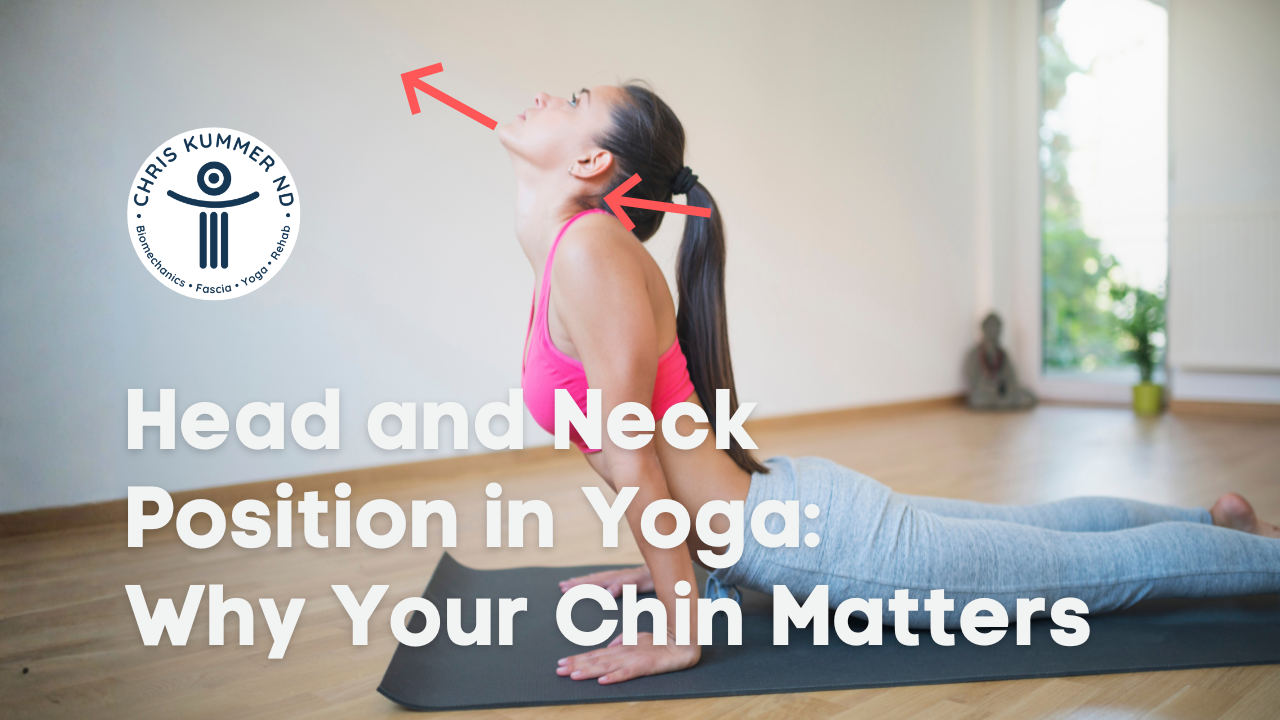
If there’s one area in yoga that gets consistently overlooked—but has an enormous influence on your practice—it’s the position of your head and neck. While most students focus on the shape of their legs, arms, or overall posture, the alignment of the cervical spine is often treated as an afterthought. Yet the head and neck determine far more than most practitioners realise: your breathing quality, your balance, your shoulder tension, your sense of orientation, and even the safety of your backbends.
Especially in modern yoga practice, where looking up, looking forward, dropping the head back, or “softening the throat” are common cues, understanding what’s actually happening in the neck becomes essential.
Let’s explore why your chin position matters more than you think—and how refining this subtle detail can change your entire practice.
The Neck Is Not Separate From the Spine
This is the foundational concept:
Your neck is your spine.
The cervical spine is simply the top portion of the same spinal column that runs all the way down to your tailbone.
It is:
- delicate but highly mobile
- home to essential nerves and blood vessels
- responsible for positioning an object (your head!) that weighs 4–6 kg
- a major contributor to balance and proprioception
- a zone where tension and compensation accumulate easily
Because the neck is both mobile and load-bearing, it must be treated with the same care as the lumbar spine or the hips. But yoga cues often encourage head movements without considering the underlying anatomy.
Head Position Increases or Decreases Spinal Load
The farther your head moves away from its neutral alignment over your shoulders, the more load the neck must absorb.
In everyday life, this is known as forward head posture—a posture nearly everyone has developed from screens, phones, and driving. For every 2–2.5 cm the head moves forward, the neck experiences dramatically increased strain.
In yoga, the same mechanics apply:
- lifting the chin too early
- dropping the head back without support
- pushing the head forward in transitions
- collapsing the back of the neck in backbends
These actions change the distribution of spinal forces and often lead to tension, discomfort, or dizziness.
But there’s another important layer most practitioners don’t realize…
Your Neck Contains Two of Your Brain’s Most Important Arteries
Running through openings in the cervical vertebrae are the vertebral arteries—two of the six major arteries supplying your brain.
They are protected, but they are also affected by:
- cervical rotation
- cervical extension (looking up)
- sudden or unsupported neck movements
- habitual postural collapse
When you tilt your head back abruptly, the cervical spine can “kink” at one specific point—often C5–C6 or C6–C7. If you’ve ever:
- seen stars
- experienced grey vision
- felt a moment of dizziness
during yoga or any form of neck extension, this is not mystical, nor is it a good sign.
It is an indication that blood flow to part of your brain momentarily decreased.
Yoga teachers occasionally joke about this visual effect… but it is not something to joke about. Understanding how neck position affects these arteries is a key part of safe, intelligent practice.
Common Yoga Cues That Can Compromise the Neck
Several familiar instructions can unintentionally create neck collapse or artery compression.
1. “Look up.”
Used in Upward Dog, Cobra, Standing Backbend, Warrior I, Crescent Lunge.
The problem? Without support from the rest of the spine or the deep cervical flexors, most students hinge the head backward instead of lengthening upward.
2. “Drop your head back.”
Often heard in Camel Pose, Wheel, Dancer, Bridge.
This cue encourages the head to fall into full cervical extension without any muscular control.
3. “Chin up.”
Used in transitions, some pranayama instructions, and heart-opening poses.
Lifting the chin without lifting the sternum or lengthening the spine shortens the back of the neck.
4. “Gaze to the ceiling.”
Very common.
Issue: Students chase the visual target and sacrifice cervical stability.
Understanding the mechanics behind these movements allows you to refine them—not avoid them entirely.
A Supportive Neck: What It Actually Looks Like
A stable, safe, and functional neck position in yoga has three key characteristics:
1. The spine stays long.
Whether the neck is flexing, extending, rotating, or side-bending, length must be maintained.
This means thinking forward and up, not just “back.”
2. The movement is distributed across the whole spine.
A healthy backbend or twist does not hinge in one spot.
Your thoracic spine should participate.
Your pelvis should support.
Your neck should be the upper continuation of a curve—not the whole curve.
3. The head is lifted, not dropped.
The weight of the head must be actively supported, especially in:
- backbends
- balance poses
- transitions
- any pose involving upward gaze
This support comes from the deep neck flexors—not the superficial muscles.
Why Your Chin Matters: The Role of the Deep Neck Flexors
When you gently draw your chin slightly inward and up (not down) you activate the deep cervical flexors—the muscles designed to stabilise your neck and balance your head over your spine.
These muscles:
- improve posture
- reduce neck pain
- assist with breathing mechanics
- stabilise the cervical spine
- prevent kinking during extension
Practicing chin support and lifting from the sternum rather than the throat changes everything about how safe and empowered you feel in your practice.
Are you thinking 'yeah this makes sense to me'?
Most important now is to keep your movement practice up. Maybe you want to integrate. and try out what the blog post added to your ideas. Then add to your knowledge. Keep expanding. We are always changing - stay adaptable to make the most of all the situations of your life.
JOIN MY NEWSLETTER
Subscribe to get my latest movement related content by email.
Double opt-in, please click 'confirm subscription' in your email inbox
